Minggu, 02 Oktober 2011

Free PDF

Free PDF

Never ever mind if you do not have enough time to go to the book establishment and also search for the preferred publication to review. Nowadays, the on-line book is coming to offer simplicity of reviewing routine. You may not have to go outdoors to look guide Searching and downloading guide entitle in this article will provide you better remedy. Yeah, on-line e-book is a sort of digital publication that you can get in the web link download given.


Free PDF

Reserve is one of the precious worth that will certainly make you always abundant. It will certainly not imply as abundant as the money offer you. When some individuals have absence to deal with the life, people with lots of e-books in some cases will certainly be wiser in doing the life. Why must be e-book It is actually not suggested that book will provide you power to get to everything. Guide is to check out and also what we indicated is the publication that is read. You could additionally see just how guide entitles and numbers of book collections are supplying here.

However, do you assume that reading book will make you really feel bored? In some cases, when you constantly check out and also end up guide swiftly as well as fast, you will feel so burnt out to spend sometimes to read. Below, you could anticipate having only little time in a day or juts for investing your free time. And also the book that we come now is , so it will certainly make some enjoyable for you.

Knowing the way how to get this book is also useful. You have actually remained in appropriate website to begin getting this details. Get the link that we give here and visit the link. You can order guide or get it when possible. You could quickly download this after obtaining offer. So, when you need guide rapidly, you can directly obtain it. It's so very easy therefore fats, isn't it? You have to prefer to through this.

By downloading this soft file publication in the online web link download, you are in the very first step right to do. This website really provides you convenience of the best ways to get the very best e-book, from best seller to the brand-new launched publication. You could discover a lot more books in this site by visiting every web link that we supply. One of the collections, is among the very best collections to market. So, the initial you get it, the first you will certainly obtain all good concerning this e-book

Product details

File Size: 1738 KB

Print Length: 168 pages

Page Numbers Source ISBN: 1502304635

Simultaneous Device Usage: Unlimited

Publisher: Jakub Marian (September 4, 2014)

Publication Date: September 4, 2014

Sold by: Amazon Digital Services LLC

Language: English

ASIN: B00NCGWW5A

Text-to-Speech:

Enabled

P.when("jQuery", "a-popover", "ready").execute(function ($, popover) {

var $ttsPopover = $('#ttsPop');

popover.create($ttsPopover, {

"closeButton": "false",

"position": "triggerBottom",

"width": "256",

"popoverLabel": "Text-to-Speech Popover",

"closeButtonLabel": "Text-to-Speech Close Popover",

"content": '

' + "Text-to-Speech is available for the Kindle Fire HDX, Kindle Fire HD, Kindle Fire, Kindle Touch, Kindle Keyboard, Kindle (2nd generation), Kindle DX, Amazon Echo, Amazon Tap, and Echo Dot." + '
'

});

});

X-Ray:

Not Enabled

P.when("jQuery", "a-popover", "ready").execute(function ($, popover) {

var $xrayPopover = $('#xrayPop_DE6D868A524C11E9B53ECED72921E34A');

popover.create($xrayPopover, {

"closeButton": "false",

"position": "triggerBottom",

"width": "256",

"popoverLabel": "X-Ray Popover ",

"closeButtonLabel": "X-Ray Close Popover",

"content": '

' + "X-Ray is not available for this item" + '
',

});

});

Word Wise: Enabled

Lending: Not Enabled

Screen Reader:

Supported

P.when("jQuery", "a-popover", "ready").execute(function ($, popover) {

var $screenReaderPopover = $('#screenReaderPopover');

popover.create($screenReaderPopover, {

"position": "triggerBottom",

"width": "500",

"content": '

' + "The text of this e-book can be read by popular screen readers. Descriptive text for images (known as “ALT text”) can be read using the Kindle for PC app and on Fire OS devices if the publisher has included it. If this e-book contains other types of non-text content (for example, some charts and math equations), that content will not currently be read by screen readers. Learn more" + '
',

"popoverLabel": "The text of this e-book can be read by popular screen readers. Descriptive text for images (known as “ALT text”) can be read using the Kindle for PC app if the publisher has included it. If this e-book contains other types of non-text content (for example, some charts and math equations), that content will not currently be read by screen readers.",

"closeButtonLabel": "Screen Reader Close Popover"

});

});

Enhanced Typesetting:

Enabled

P.when("jQuery", "a-popover", "ready").execute(function ($, popover) {

var $typesettingPopover = $('#typesettingPopover');

popover.create($typesettingPopover, {

"position": "triggerBottom",

"width": "256",

"content": '

' + "Enhanced typesetting improvements offer faster reading with less eye strain and beautiful page layouts, even at larger font sizes. Learn More" + '
',

"popoverLabel": "Enhanced Typesetting Popover",

"closeButtonLabel": "Enhanced Typesetting Close Popover"

});

});

Amazon Best Sellers Rank:

#341,568 Paid in Kindle Store (See Top 100 Paid in Kindle Store)

I am a rather new author and published my first book in 2012. Many people were surprised my English was "so good"... Indeed, I am not a native English speaker but it is true English has become my normal vehicle in my professional life. As such I am fully aware I always have a lot to learn to improve myself. This book perfectly fits the bill. It is pleasant to read while I tell myself often ... gosh ... I did not know this... I guess I will have to keep it under my pillow...

The book is well written and well structured. Author tried to be as clear as possible in his exposition - every article contains an example of a mistake and its corrected version. Care is taken to track differences between British and American English. All in all, I liked the book very much. I found a few mistakes not covered though (maybe these weren't considered to be the most common).

It's good. I've learned a great deal. Thanks.

It is a wonderful guide for a foreigner trying to master the intricacies of a language which in appearance looks so easy, but as it is said: still waters run deep.

A must have book for non-native english speakers!!

Love the book, I use it as a reference book sometime when I'm not sure how to use a certain gramar

Readable, handy.

I am a native born American with a Masters degree. I am in the process of writing a book and I find this book helpful. So don't think that this book is only applicable to individuals not born in America. I wish I had this book in high school or college. There are a lot of common mistakes as this book points out that everyday American's even educated American's make when they speak and write.

PDF
EPub
Doc
iBooks
rtf
Mobipocket
Kindle

PDF

PDF

PDF
PDF

Rabu, 14 September 2011

Ebook Free Cuba and Its Neighbours: Democracy in MotionBy Arnold August

Ebook Free Cuba and Its Neighbours: Democracy in MotionBy Arnold August

By checking out Cuba And Its Neighbours: Democracy In MotionBy Arnold August, you can know the expertise and also points even more, not only regarding just what you obtain from individuals to people. Reserve Cuba And Its Neighbours: Democracy In MotionBy Arnold August will certainly be a lot more trusted. As this Cuba And Its Neighbours: Democracy In MotionBy Arnold August, it will actually give you the great idea to be successful. It is not only for you to be success in certain life; you can be effective in everything. The success can be begun by knowing the fundamental understanding as well as do activities.

Cuba and Its Neighbours: Democracy in MotionBy Arnold August

Cuba and Its Neighbours: Democracy in MotionBy Arnold August


Cuba and Its Neighbours: Democracy in MotionBy Arnold August


Ebook Free Cuba and Its Neighbours: Democracy in MotionBy Arnold August

Cuba And Its Neighbours: Democracy In MotionBy Arnold August. Discovering how to have reading behavior resembles learning to try for consuming something that you actually do not really want. It will need even more times to aid. In addition, it will likewise little bit force to offer the food to your mouth and also swallow it. Well, as reviewing a publication Cuba And Its Neighbours: Democracy In MotionBy Arnold August, sometimes, if you should review something for your brand-new jobs, you will feel so dizzy of it. Also it is a book like Cuba And Its Neighbours: Democracy In MotionBy Arnold August; it will make you feel so bad.

This location is an on-line publication that you can locate as well as enjoy several kinds of book brochures. There will come several differences of exactly how you discover Cuba And Its Neighbours: Democracy In MotionBy Arnold August in this internet site and also off library or guide shops. But, the significant reason is that you may not go for lengthy moment to seek for guide. Yeah, you have to be smarter in this modern-day era. By advanced technology, the internet library and shop is offered.

Currently, when you begin to read this Cuba And Its Neighbours: Democracy In MotionBy Arnold August, perhaps you will think of exactly what you can obtain? Several things! In short we will certainly answer it, however, to know exactly what they are, you need to read this publication on your own. You understand, by checking out continually, you could really feel not just better but also brighter in the life. Reviewing should be worked as the behavior, as leisure activity. So when you are supposed to check out, you could conveniently do it. Besides, by reading this book, you could likewise easily make ea new method to believe and feel well and also sensibly. Yeah, life carefully as well as smartly is much needed.

Be the initial to download this publication Cuba And Its Neighbours: Democracy In MotionBy Arnold August and also let checked out by coating. It is really easy to review this publication Cuba And Its Neighbours: Democracy In MotionBy Arnold August considering that you don't need to bring this published Cuba And Its Neighbours: Democracy In MotionBy Arnold August anywhere. Your soft documents e-book can be in our gadget or computer system so you could delight in checking out anywhere and also each time if needed. This is why great deals numbers of individuals also check out guides Cuba And Its Neighbours: Democracy In MotionBy Arnold August in soft fie by downloading and install the publication. So, be among them which take all benefits of reviewing the e-book Cuba And Its Neighbours: Democracy In MotionBy Arnold August by on-line or on your soft documents system.

Cuba and Its Neighbours: Democracy in MotionBy Arnold August

In this groundbreaking book, Arnold August explores Cuba's unique form of democracy, presenting a detailed and balanced analysis of Cuba's electoral process and the state's functioning between elections. By comparing them with practices in the U.S., Venezuela, Bolivia and Ecuador, August shows that people's participation in politics and society is not limited to a singular, U.S.- centric understanding of democracy.

Through this deft analysis, August illustrates how the process of democratization in Cuba is continually in motion and argues that a greater understanding of different political systems teaches us to not be satisfied with either blanket condemnations or idealistic political illusions.


  • Sales Rank: #811048 in Books
  • Brand: Brand: Zed Books
  • Published on: 2013-04-11
  • Original language: English
  • Number of items: 1
  • Dimensions: 8.50" h x .60" w x 5.44" l, 1.15 pounds
  • Binding: Paperback
  • 288 pages
Features
  • Used Book in Good Condition

Review

"A must-read for anybody seriously interested in Cuba and in the overall question of democracy and its practices." - Claudia Kaiser-Lenoir, Tufts University

"Arnold August cuts through the common propaganda about democracy in the U.S. and the supposed lack of democracy in Cuba. Where August's earlier work on the Cuban political system opened a window to this forbidden island, Cuba and Its Neighbours deepens our understanding of Cuba's participatory processes and shows how they have been shaped by Cuba's revolutionary history." - Cliff DuRand, Research Associate, Center for Global Justice, Professor emeritus of Social Philosophy, Morgan State University, Baltimore

"A trailblazing perspective. August contrasts the experiences in Cuba and some Latin American countries, where participatory democracy is taking shape, to the pretences of the U.S. model. Compulsory reading." - Claude Morin, Université de Montréal

"This book, a tour de force from an expert who clearly knows his field well, is one that goes out of its way to make us think about what we understand by 'democracy' and how we should view new manifestations in the 'Third World'. Not only is its conceptual and geographical scope admirably broad, but its familiar attention to the details of political participation are excellent, and, by taking a firm stance, the author forces us to address issues which are all too often taken for granted and left unquestioned." - Antoni Kapcia, The University of Nottingham

From the Author
My first book, published in 1999, dealt only with elections and democracy in Cuba. This book, "Cuba and Its Neighbours: Democracy in Motion", is entirely different as the following Table of Contents indicates:

Part I Clearing the Cobwebs Around Democracy

Chapter 1  Democracy and U.S.-Centrism
Democracy or Democratization?
Democratization from the Bottom Up: Occupying Public Spaces (2011-12)

Chapter 2  Democracy in the U.S.
Birth of the U.S. and the American Dream
Foreign Policy Toward Its Neighbours and Democracy Promotion
Founding Fathers' Heritage and Voter Turnout
Competitive Multi-Party Democratic Elections: Obama Case Study
Co-Optation and Individual Opportunism
The Credibility Gap
Obama's First Experiences and Reactions
Obama's Foreign Policy: The "New Face" and Cuba
Honduras: The "Reluctant Sheriff"
The Occupy Movement: Breaking Out of U.S.-Centrism?
The November 2012 Elections and Obama

Chapter 3  Exploring Democracies in Venezuela, Bolivia and Ecuador
Venezuela: New Experiments in Participatory Democracy
Bolivia's Democracy in Motion: On the Edge
Ecuador's New Constitution: Sumak Kawsay and Participatory Democracy
ALBA, CELAC and U.S. Democracy Promotion

Part II Cuba: Constitutions, Elections and New States

Chapter 4  Participation in Constitutions, Elections and a New State (1868-1952)Cuba's First Homegrown Constitutions,
Embryonic States and Elections (1868-98)
Cuba, U.S. Freedom of the Press and Military Intervention (1898)
U.S. Domination, Interference and Co-Optation vs. Democracy (1898-1952)

Chapter 5  Democracy, Elections and the New State
A Rebellion Against Dogmatism of the Left and the Batista Dictatorship (1953)
Participatory Nineteenth-Century Republic in Arms Reborn (1957-58)
Lessons for Today from 1958: Grass-Roots Democracy vs. Elections,
Co-Optation, Dissidence
The Provisional Revolutionary Government and Constitution (1959)
Elections: Who Rejected Them?
Elections Analysis: Then and Now
Participatory Democracy and U.S. Frustrations
Democratization Through Mass Organizations and Participation
Initial Attempts to Establish Local Governments and Elections
Origins of the PCC: Yesterday and Today
Elections, New State Structure and Constitution (1970-76)

Part III  Contemporary Cuba:  The Test for Democratization

Chapter 6  The 2011-12 Communist Party Congress and Conference: Democratization and the Press
Democratization Through People's Control and the Press
Opening the Debate
The 2011 Party Congress Deliberations: Input and People's Control
The Dialectics of Discrepancies and Consensus: Democracy in Motion
Congress Guidelines: Application and People's Participation
The 2012 PCC Conference and the Press: Trials and Tribulations
Participatory Democracy, the Press and Social Scientists
Capitalism, Socialism and Cuba's Errors

Chapter 7  Elections in Contemporary Cuba
The Cuban Electoral Process: An Overview
The Soviet Political Model: A Cuban Import?
The 1992 Constitutional Reforms and Their Impact on Elections
Elections, Constitution and Political System
General Elections -- First Phase: Municipal Elections
Decentralization
Voter Registration
Nominating Candidates for Elections to the Municipal Assemblies
The PCC in the Nomination Process
Debating the Improvement of Nomination Assemblies
Elections to the Municipal Assemblies
Analyzing Municipal Election Results
General Elections -- Second Phase: The National anpp
The Candidacies Commissions and Nominations
Improving the Candidacies Commissions
Elections to the ANPP
The Slate vs. Selective Vote: A Rejection of the Government?
One Candidate for Election per anpp Seat: Talking Figures
Who Are the Deputies? Talking Quality
Composition of the ANPP
"Almost All Deputies Are Communist Party Members"
Elections: ANPP Officials, Council of State and Its President, Raúl Castro

Chapter 8  The ANPP and the Municipality: Functioning Between Elections
Are Democratization and Revolutionary Leadership Compatible?
Who Legislates?
Case Study: Participation in Drafting the Social Security Bill
Unanimity in the ANPP
The ANPP and Cuba's Foreign Policy
Municipal-Level Participation: Limits and Perspectives
Cuban Democracy: Representative or Participatory?
People's Councils: Potential for Further Democratization
The Potential of the Local Level and Need for Enhanced Participation

Conclusion: The Future of Democratization: Facing the Tests

About the Author
Arnold August holds a Master's degree in political science from McGill University, Montreal. The Montreal-based author, journalist and lecturer is the author of Democracy in Cuba and the 1997-98 Elections (Editorial José Martí, Havana, 1999). He has also contributed a chapter entitled "Socialism and Elections" to the edited collection Cuban Socialism in a New Century (University Press of Florida, 2004, Contemporary Cuba series edited by JohnKirk).


In 2013, Cuba and Its Neighbours: Democracy in Motion was co-published in English byZed Books (UK) and Fernwood Publishing (Canada), distributed in the U.S. byUniversity of Chicago Press. The countries under consideration are the U.S.,Venezuela, Bolivia, Ecuador and Cuba. The common thread is participatory democracy.

In 2015,the Spanish version was published in Cuba by CienciasSociales.


t was also releasedin 2015 in Korean by a progressive South Korean publisher.


Between2007 and 2015, as part of the opposition to ongoing media disinformation on current affairs, he wrote more than 60 articles on Cuba and Latin America (mainly Honduras and Venezuela) and on the U.S. published on many websites around the world, most of them bilingually in English and Spanish. In the same period, he was interviewed on dozens of alternative radio programs in the U.S. and Canada.


Since 1999, based on his books published in English, he has given conferences and lectures in universities in the U.S.,Canada, Europe, Cuba and Puerto Rico.


He is a member of the Latin American Studies Association (LASA, based in the U.S.), the Canadian Association for Latin American and Caribbean Studies (CALACS) and the Cuba Research Forum at the University of Nottingham (UK).
 

Cuba and Its Neighbours: Democracy in MotionBy Arnold August PDF
Cuba and Its Neighbours: Democracy in MotionBy Arnold August EPub
Cuba and Its Neighbours: Democracy in MotionBy Arnold August Doc
Cuba and Its Neighbours: Democracy in MotionBy Arnold August iBooks
Cuba and Its Neighbours: Democracy in MotionBy Arnold August rtf
Cuba and Its Neighbours: Democracy in MotionBy Arnold August Mobipocket
Cuba and Its Neighbours: Democracy in MotionBy Arnold August Kindle

Cuba and Its Neighbours: Democracy in MotionBy Arnold August PDF

Cuba and Its Neighbours: Democracy in MotionBy Arnold August PDF

Cuba and Its Neighbours: Democracy in MotionBy Arnold August PDF

Selasa, 13 September 2011

Ebook Download Socratic Logic: A Logic Text using Socratic Method, Platonic Questions, and Aristotelian Principles, Edition 3.1

Ebook Download Socratic Logic: A Logic Text using Socratic Method, Platonic Questions, and Aristotelian Principles, Edition 3.1

Things to do and get over with the existence of the requirements can be accomplished by taking such provided function of publication. Customarily, book will certainly work not just for the expertise and something so. However, practically, it will additionally show you exactly what to do as well as not to do. When you have actually wrapped up that the book used, you may have the ability to locate what exactly the author will certainly share to you.
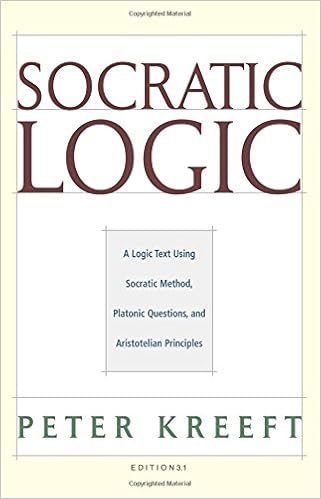
Socratic Logic: A Logic Text using Socratic Method, Platonic Questions, and Aristotelian Principles, Edition 3.1

Socratic Logic: A Logic Text using Socratic Method, Platonic Questions, and Aristotelian Principles, Edition 3.1


Socratic Logic: A Logic Text using Socratic Method, Platonic Questions, and Aristotelian Principles, Edition 3.1


Ebook Download Socratic Logic: A Logic Text using Socratic Method, Platonic Questions, and Aristotelian Principles, Edition 3.1

Why must select the headache one if there is simple? Obtain the profit by acquiring the book Socratic Logic: A Logic Text Using Socratic Method, Platonic Questions, And Aristotelian Principles, Edition 3.1 here. You will certainly obtain various way to make a deal as well as obtain guide Socratic Logic: A Logic Text Using Socratic Method, Platonic Questions, And Aristotelian Principles, Edition 3.1 As known, nowadays. Soft documents of guides Socratic Logic: A Logic Text Using Socratic Method, Platonic Questions, And Aristotelian Principles, Edition 3.1 come to be preferred amongst the readers. Are you among them? As well as right here, we are supplying you the brand-new compilation of ours, the Socratic Logic: A Logic Text Using Socratic Method, Platonic Questions, And Aristotelian Principles, Edition 3.1.

When some individuals taking a look at you while reading Socratic Logic: A Logic Text Using Socratic Method, Platonic Questions, And Aristotelian Principles, Edition 3.1, you might really feel so honored. But, rather than other people feels you must instil in on your own that you are reading Socratic Logic: A Logic Text Using Socratic Method, Platonic Questions, And Aristotelian Principles, Edition 3.1 not due to that factors. Reading this Socratic Logic: A Logic Text Using Socratic Method, Platonic Questions, And Aristotelian Principles, Edition 3.1 will certainly provide you more than individuals appreciate. It will guide to know more than the people staring at you. Already, there are lots of sources to knowing, reviewing a publication Socratic Logic: A Logic Text Using Socratic Method, Platonic Questions, And Aristotelian Principles, Edition 3.1 still ends up being the front runner as a great means.

It will not take more time to obtain this Socratic Logic: A Logic Text Using Socratic Method, Platonic Questions, And Aristotelian Principles, Edition 3.1 It will not take more money to publish this book Socratic Logic: A Logic Text Using Socratic Method, Platonic Questions, And Aristotelian Principles, Edition 3.1 Nowadays, people have been so smart to utilize the modern technology. Why don't you use your gizmo or various other device to conserve this downloaded and install soft file e-book Socratic Logic: A Logic Text Using Socratic Method, Platonic Questions, And Aristotelian Principles, Edition 3.1 By doing this will certainly allow you to consistently be come with by this publication Socratic Logic: A Logic Text Using Socratic Method, Platonic Questions, And Aristotelian Principles, Edition 3.1 Obviously, it will be the very best friend if you read this e-book Socratic Logic: A Logic Text Using Socratic Method, Platonic Questions, And Aristotelian Principles, Edition 3.1 till finished.

Providing great publication for the visitors is kind of pleasure for us. This is why, the books that we offered always guides with extraordinary factors. You can take it in the kind of soft data. So, you could review Socratic Logic: A Logic Text Using Socratic Method, Platonic Questions, And Aristotelian Principles, Edition 3.1 quickly from some gadget to make best use of the modern technology use. When you have determined making this book as one of referred publication, you can provide some finest for not just your life however also your individuals about.

Socratic Logic: A Logic Text using Socratic Method, Platonic Questions, and Aristotelian Principles, Edition 3.1

Excerpt. © Reprinted by permission. All rights reserved.

An excerpt from chapter 1:Section 3. The two logics (P)(This section can be omitted without losing anything you will need later on in the book. It’s here both to satisfy the advanced student’s curiosity and to sell the approach of this book to prospective teachers who may question its emphasis on Aristotelian rather than symbolic logic, by justifying this choice philosophically.)     Almost four hundred years before Christ, Aristotle wrote the world’s first logic textbook. Actually it was six short books, which collectively came to be known as the Organon, or “instrument.” From then until 1913, when Bertrand Russell and Alfred North Whitehead published Principia Mathematica, the first classic of mathematical or symbolic logic, all students learned Aristotelian logic, the logic taught in this book.      The only other “new logic” for twenty-four centuries was an improvement on the principles of inductive logic by Francis Bacon’s Novum Organum (“New Or-ganon”), in the 17th century, and another by John Stuart Mill, in the 19th century.     (Inductive reasoning could be very roughly and inadequately defined as reasoning from concrete particular instances, known by experience, while deduction reasons from general principles. Induction yields only probability, while deduction yields certainty. “Socrates, Plato and Aristotle are mortal, therefore probably all men are mortal” is an example of inductive reasoning; “All men are mortal, and Socrates is a man, therefore Socrates is mortal” is an example of deductive reasoning.)      Today nearly all logic textbooks use the new mathematical, or symbolic, logic as a kind of new language system for deductive logic. (It is not a new logic; logical principles are unchangeable, like the principles of algebra. It is more like changing from Roman numerals to Arabic numerals.) There are at least three reasons for this change:     (1) The first and most important one is that the new logic really is superior to the old in efficiency for expressing many long and complex arguments, as Arabic numerals are to Roman numerals, or a digital computer to an analog computer, or writing in shorthand to writing in longhand.     However, longhand is superior to shorthand in other ways: e.g. it has more beauty and elegance, it is intelligible to more people, and it gives a more personal touch. That is why most people prefer longhand most of the time – as most beginners prefer simpler computers (or even pens). It is somewhat similar in logic: most people “argue in longhand,” i.e. ordinary language; and Aristotelian logic stays close to ordinary language. That is why Aristotelian logic is more practical for beginners.      Even though symbolic language is superior in sophistication, it depends on commonsense logic as its foundation and root. Thus you will have a firmer foundation for all advanced logics if you first master this most basic logic. Strong roots are the key to healthy branches and leaves for any tree. Any farmer knows that the way to get better fruit is to tend the roots, not the fruits. (This is only an analogy. Analogies do not prove anything – that is a common fallacy – they only illuminate and illustrate. But it is an illuminating analogy.)     Modern symbolic logic is mathematical logic. “Modern symbolic logic has been developed primarily by mathematicians with mathematical applications in mind.” This from one of its defenders, not one of its critics (Henry C. Bayerly, in A Primer of Logic. N.Y.: Harper & Row, 1973, p.4).     Mathematics is a wonderful invention for saving time and empowering science, but it is not very useful in most ordinary conversations, especially philosophical conversations. The more important the subject matter, the less relevant mathematics seems. Its forte is quantity, not quality. Mathematics is the only totally clear, utterly unambiguous language in the world; yet it cannot say anything very interesting about anything very important. Compare the exercises in a symbolic logic text with those in this text. How many are taken from the Great Books? How many are from conversations you could have had in real life?      (2) A second reason for the popularity of symbolic logic is probably its more scientific and exact form. The very artificiality of its language is a plus for its defenders. But it is a minus for ordinary people. In fact, Ludwig Wittgenstein, probably the most influential philosophical logician of the 20th century, admitted, in Philosophical Investigations, that “because of the basic differences between natural and artificial languages, often such translations [between natural-language sentences and artificial symbolic language] are not even possible in principle.” “Many logicians now agree that the methods of symbolic logic are of little practical usefulness in dealing with much reasoning encountered in real-life situations” (Stephen N. Thomas, Practical Reasoning in Natural Language, Prentice-Hall, 1973).      – And in philosophy! “However helpful symbolic logic may be as a tool of the . . . sciences, it is [relatively] useless as a tool of philosophy. Philosophy aims at insight into principles and into the relationship of conclusions to the principles from which they are derived. Symbolic logic, however, does not aim at giving such insight” (Andrew Bachhuber, Introduction to Logic (New York: Appleton-Century Crofts, 1957), p. 318).     (3) But there is a third reason for the popularity of symbolic logic among philosophers, which is more substantial, for it involves a very important difference in philosophical belief. The old, Aristotelian logic was often scorned by 20th century philosophers because it rests on two commonsensical but unfashionable philosophical presuppositions. The technical names for them are “epistemological realism” and “metaphysical realism.” These two positions were held by the vast majority of all philosophers for over 2000 years (roughly, from Socrates to the 18th century) and are still held by most ordinary people today, since they seem so commonsensical, but they were not held by many of the influential philosophers of the past three centuries.      (The following summary should not scare off beginners; it is much more abstract and theoretical than most of the rest of this book.)      The first of these two presuppositions, “epistemological realism,” is the belief that the object of human reason, when reason is working naturally and rightly, is objective reality as it really is; that human reason can know objective reality, and can sometimes know it with certainty; that when we say “two apples plus two apples must always be four apples,” or that “apples grow on trees,” we are saying something true about the universe, not just about how we think or about how we choose to use symbols and words. Today many philosophers are skeptical of this belief, and call it naïve, largely because of two 18th century “Enlightenment” philosophers, Hume and Kant.     Hume inherited from his predecessor Locke the fatal assumption that the immediate object of human knowledge is our own ideas rather than objective reality. Locke naïvely assumed that we could know that these ideas “corresponded” to objective reality, somewhat like photographs; but it is difficult to see how we can be sure any photograph accurately corresponds to the real object of which it is a photograph if the only things we can ever know directly are photographs and not real objects. Hume drew the logical conclusion of skepticism from Locke’s premise.      Once he limited the objects of knowledge to our own ideas, Hume then distinguished two kinds of propositions expressing these ideas: what he called “matters of fact” and “relations of ideas.”     What Hume called “relations of ideas” are essentially what Kant later called “analytic propositions” and what logicians now call “tautologies”: propositions that are true by definition, true only because their predicate merely repeats all or part of their subject (e.g. “Trees are trees” or “Unicorns are not non-unicorns” or “Unmarried men are men”).      What Hume called “matters of fact” are essentially what Kant called “synthetic propositions,” propositions whose predicate adds some new information to the subject (like “No Englishman is 25 feet tall” or “Some trees never shed their leaves”); and these “matters of fact,” according to Hume, could be known only by sense observation. Thus they were always particular (e.g. “These two men are bald”) rather than universal (e.g. “All men are mortal”), for we do not sense universals (like “all men”), only particulars (like “these two men”).      Common sense says that we can be certain of some universal truths, e.g., that all men are mortal, and therefore that Socrates is mortal because he is a man. But according to Hume we cannot be certain of universal truths like “all men are mortal” because the only way we can come to know them is by generalizing from particular sense experiences (this man is mortal, and that man is mortal, etc.); and we cannot sense all men, only some, so our generalization can only be probable. Hume argued that particular facts deduced from these only-probable general principles could never be known or predicted with certainty. If it is only probably true that all men are mortal, then it is only probably true that Socrates is mortal. The fact that we have seen the sun rise millions of times does not prove that it will necessarily rise tomorrow. Hume’s “bottom line” conclusion from this analysis is skepticism: there is no certain knowledge of objective reality (“matters of fact”), only of our own ideas (“relations of ideas”). We have only probable knowledge of objective reality. Even scientific knowledge, Hume thought, was only probable, not certain, because science assumes the principle of causality, and this principle, according to Hume, is only a subjective association of ideas in our minds. Because we have seen a “constant conjunction” of birds and eggs, because we have seen eggs follow birds so often, we naturally assume that the bird is the cause of the egg. But we do not see causality itself, the causal relation itself between the bird and the egg. And we certainly do not see (with our eyes) the universal “principle of causality.” So Hume concluded that we do not really have the knowledge of objective reality that we naturally think we have. We must be skeptics, if we are only Humean beings.     Kant accepted most of Hume’s analysis but said, in effect, “I Kant accept your skeptical conclusion.” He avoided this conclusion by claiming that human knowledge does not fail to do its job because its job is not to conform to objective reality (or “things-in-themselves,” as he called it), i.e. to correspond to it or copy it. Rather, knowledge constructs or forms reality as an artist constructs or forms a work of art. The knowing subject determines the known object rather than vice versa. Human knowledge does its job very well, but its job is not to learn what is, but to make what is, to form it and structure it and impose meanings on it. (Kant distinguished three such levels of imposed meanings: the two “forms of apperception”: time and space; twelve abstract logical “categories” such as causality, necessity, and relation; and the three “ideas of pure reason”: God, self, and world.) Thus the world of experience is formed by our knowing it rather than our knowledge being formed by the world. Kant called this idea his “Copernican Revolution in philosophy.” It is sometimes called “epistemological idealism” or “Kantian idealism,” to distinguish it from epistemological realism.     (“Epistemology” is that division of philosophy which studies human knowing. The term “epistemological idealism” is sometimes is used in a different way, to mean the belief that ideas rather than objective reality are the objects of our knowledge; in that sense, Locke and Hume are epistemological idealists too. But if we use “epistemological idealism” to mean the belief that the human idea (or knowing, or consciousness) determines its object rather than being determined by it, then Kant is the first epistemological idealist.)      The “bottom line” for logic is that if you agree with either Hume or Kant, logic becomes the mere manipulation of our symbols, not the principles for a true orderly knowledge of an ordered world. For instance, according to epistemological idealism, general “categories” like “relation” or “quality” or “cause” or “time” are only mental classifications we make, not real features of the world that we discover.      In such a logic, “genus” and “species” mean something very different than in Aristotelian logic: they mean only any larger class and smaller sub-class that we mentally construct. But for Aristotle a “genus” is the general or common part of a thing’s real essential nature (e.g. “animal” is man’s genus), and a “species” is the whole essence (e.g. “rational animal” is man’s species). (See Chapter III, Sections 2 and 3.)     Another place where modern symbolic logic merely manipulates mental symbols while traditional Aristotelian logic expresses insight into objective reality is the interpretation of a conditional (or “hypothetical”) proposition such as “If it rains, I will get wet.” Aristotelian logic, like common sense, interprets this proposition as an insight into real causality: the rain causes me to get wet. I am predicting the effect from the cause. But symbolic logic does not allow this commonsensical, realistic interpretation. It is skeptical of the “naïve” assumption of epistemological realism, that we can know real things like real causality; and this produces the radically anti-commonsensical (or, as they say so euphemistically, “counter-intuitive”) “problem of material implication” (see page 23).     Besides epistemological realism, Aristotelian logic also implicitly assumes metaphysical realism. (Metaphysics is that division of philosophy which investigates what reality is; epistemology is that division of philosophy which investigates what knowing is.) Epistemological realism contends that the object of intelligence is reality. Metaphysical realism contends that reality is intelligible; that it includes a real order; that when we say “man is a rational animal,” e.g., we are not imposing an order on a reality that is really random or chaotic or unknowable; that we are expressing our discovery of order, not our creation of order; that “categories” like “man” or “animal” or “thing” or “attribute” are taken from reality into our language and thought, not imposed on reality from our language and thought.      Metaphysical realism naturally goes with epistemological realism. Technically, metaphysical realism is the belief that universal concepts correspond to reality; that things really have common natures; that “universals” such as “human nature” are real and that we can know them.      There are two forms of metaphysical realism: Plato thought that these universals were real things in themselves, while Aristotle thought, more commonsensically, that they were real aspects of things which we mentally abstracted from things. (See Chapter II, Section 3, “The Problem of Universals.”)      The opposite of realism is “nominalism,” the belief that universals are only man-made nomini (names). William of Ockham (1285–1349) is the philosopher who is usually credited (or debited) with being the founder of nominalism. Aristotelian logic assumes both epistemological realism and metaphysical realism because it begins with the “first act of the mind,” the act of understanding a universal, or a nature, or an essence (such as the nature of “apple” or “man”). These universals, or essences, are known by concepts and expressed by what logic calls “terms.” Then two of these universal terms are related as subjects and predicates of propositions (e.g. “Apples are fruits,” or “Man is mortal”). “Aristotle never intended his logic to be a merely formal calculus [like mathematics]. He tied logic to his ontology [metaphysics]: thinking in concepts presupposes that the world is formed of stable species” (J. Lenoble, La notion de l’experience, Paris, 1930, p. 35).      Symbolic logic is a set of symbols and rules for manipulating them, without needing to know their meaning and content, or their relationship to the real world, their “truth” in the traditional, commonsensical sense of “truth.” A computer can do symbolic logic. It is quantitative (digital), not qualitative. It is reducible to mathematics.      The new logic is sometimes called “propositional logic” as well as “mathematical logic” or “symbolic logic” because it begins with propositions, not terms. For terms (like “man” or “apple”) express universals, or essences, or natures; and this implicitly assumes metaphysical realism (that universals are real) and epistemological realism (that we can know them as they really are).     Typically modern philosophers criticize this assumption as naïve, but it seems to me that this is a very reasonable assumption, and not naïve at all. Is it too naïve to assume that we know what an apple is? The new logic has no means of saying, and even prevents us from saying, what anything is!      And if we cease to say it, we will soon cease to think it, for there will be no holding-places in our language for the thought. Language is the house of thought, and homelessness is as life-threatening for thoughts as it is for people. If we should begin to speak and think only in nominalist terms, this would be a monumental historic change. It would reverse the evolutionary event by which man rose above the animal in gaining the ability to know abstract universals. It would be the mental equivalent of going naked on all fours, living in trees, and eating bugs and bananas. (Could monkeys have evolved by natural selection from nominalists?)      While it may be “extremist” to suggest it, such a mental “devolution” is not intrinsically impossible. And changes in logic are not wholly unrelated to it. Already, “internet logic,” or the logic of spontaneous association by “keywords,” is replacing “genus and species logic,” or the logic of an ordered hierarchy of objectively real categories. To most modern minds, those last seven words sound almost as archaic as alchemy or feudalism. Many criticize them as ideologically dangerous. These critics dislike categories because they “feel that” (that phrase is a category confusion, by the way) classifications, and universal statements about classes such as “Hittites could not read Hebrew,” constitute “prejudice,” “judgmentalism,” “oppression,” or even “hate speech.”      Logic and social change are not unrelated. Not only our logicians but also our society no longer thinks primarily about the fundamental metaphysical question, the question of what things are, the question of the nature of things. Instead, we think about how we feel about things, about how we can use them, how we see them behave, how they work, how we can change them, or how we can predict and control their behavior by technology. But all this does not raise us above the animal level in kind, only in degree. The higher animals too have feelings, and things to use, and sight, and action, and even a kind of technology of behavior prediction and control. For the art of hunting is an art of predicting and controlling the behavior of other animals. What do we have that no mere animal has? The thing that many modern philosophers vilify: abstraction. We have the power to abstract and understand universals. This is the thing traditional logic is founded on, and this is the thing symbolic logic ignores or denies.      Logic is deeply related to moral and ethical changes in both thought and practice. All previous societies had a strong, nearly universal, and rarely questioned consensus about at least some basic aspects of a “natural moral law,” about what was “natural” and what was “unnatural.” There may not have been a greater obedience to this law, but there was a much greater knowledge of it, or agreement about it. Today, especially in the realm of sex (by far the most radically changed area of human life in both belief and practice), our more “advanced” minds find the old language about “unnatural acts” not only “politically incorrect” but literally incomprehensible, because they no longer accept the legitimacy of the very question of the “nature” of a thing. Issues like homosexuality, contraception, masturbation, pedophilia, incest, divorce, adultery, abortion, and even bestiality are increasingly debated in other terms than the “nature” of sexuality, or the “nature” of femininity and masculinity. It is not an unthinkable suspicion that one of the most powerful forces driving the new logic is more social than philosophical, and more sexual than logical.     Symbolic logic naturally fosters utilitarian ethics, which is essentially an ethic of consequences. The fundamental principle of utilitarianism is that an act is good if its probable consequences result in “the greatest happiness for the greatest number” of people. It is an “if . . . then . . .” ethics of calculating consequences – essentially, “the end justifies the means” (though that formula is somewhat ambiguous). Symbolic logic fits this perfectly because it is essentially an “if . . . then . . .” logic, a calculation of logical consequences. Its basic unit is the proposition (p or q) and its basic judgment is “if p then q.” In contrast, Aristotelian logic naturally fosters a “natural law ethic,” an ethic of universal principles, based on the nature of things, especially the nature of man. For its basic unit is the term, a subject (S) or a predicate (P) within a proposition (p); and its basic judgment is “all S is P” – a statement of universal truth about the nature of S and P.      The very nature of reason itself is understood differently by the new symbolic logic than it was by the traditional Aristotelian logic. “Reason” used to mean essentially “all that distinguishes man from the beasts,” including intuition, understanding, wisdom, moral conscience, and aesthetic appreciation, as well as calculation. “Reason” now usually means only the last of those powers. That is why many thinkers today who seem at first quite sane in other ways actually believe that there is no fundamental difference between “natural intelligence” and “artificial intelligence” – in other words, you are nothing but a computer plus an ape. (Having met some of these people at MIT, I must admit that their self-description sometimes seems quite accurate.)     Aristotelian logic is not exact enough for the nominalistic mathematical logician, and it is too exact for the pop psychology subjectivist or New Age mystic. Out at sea there between Scylla and Charybdis, it reveals by contrast the double tragedy of modern thought in its alienation between form and matter, structure and content, validity and meaning. This alienated mind was described memorably by C.S. Lewis: “the two hemispheres of my brain stood in sharpest contrast. On the one hand, a glib and shallow rationalism. On the other, a many-islanded sea of myth and poetry. Nearly all that I loved, I believed subjective. Nearly all that was real, I thought grim and meaningless” (Surprised by Joy). Neither mathematical logic nor “experience” can heal this gap; but Aristotelian logic can. It is thought’s soul and body together, yet not confused. Mathematical logic alone is abstract and “angelistic,” and sense experience and feeling alone is concrete and “animalistic,” but Aristotelian logic is a human instrument for human beings.      Aristotelian logic is also easier, simpler, and therefore time-saving. For example, in a logic text book misleadingly entitled Practical Reasoning in Natural Language, the author takes six full pages of symbolic logic to analyze a simple syllogism from Plato’s Republic that proves that justice is not rightly defined as “telling the truth and paying back what is owed” because returning a weapon to a madman is not justice but it is telling the truth and paying back what is owed. (pp. 224–30). Another single syllogism of Hume’s takes eight pages to analyze (pp. 278–86).     I have found that students who are well trained in Aristotelian logic are much better at arguing, and at understanding arguments, than students who are trained only in symbolic logic. For Aristotelian logic is the logic of the four most basic verbal communication arts: reading, writing, listening, and speaking. It is the logic of Socrates. If you want to be a Socrates, this is the logic you should begin with.      The old logic is like the old classic movies: strong on substance rather than sophistication. The new logic is like typically modern movies: strong on “special effects” but weak on substance (theme, character, plot); strong on the technological “bells and whistles” but weak on the human side. But logic should be a human instrument; logic was made for man, not man for logic.The Problem of “Material Implication”     The following issue is quite abstract and difficult, though I shall try to make it as simple as possible. It is included because I believe it shows that “something is rotten in the state of Denmark” at the very heart of the new logic. (For a fuller treatment of the new logic see the Appendix, p. 364.)     Logic is most especially about reasoning, or inference: the process of thinking by which we draw conclusions from evidence, moving from one proposition to another. The proposition we begin with is called a “premise” and the proposition we move to, or infer, or reason to, is called a “conclusion.”      The simplest and most straightforward kind of reasoning is to move from a true premise (or, more usually, from a number of true premises together) to a true conclusion. But we can also use false propositions in good reasoning. Since a false conclusion cannot be logically proved from true premises, we can know that if the conclusion is false then one of the premises must also be false, in a logically valid argument.     A logically valid argument is one in which the conclusion necessarily follows from its premises. In a logically valid argument, if the premises are true, then the conclusion must be true. In an invalid argument this is not so. “All men are mortal, and Socrates is a man, therefore Socrates is mortal” is a valid argument. “Dogs have four legs, and Lassie has four legs, therefore Lassie is a dog” is not a valid argument. The conclusion (“Lassie is a dog”) may be true, but it has not been proved by this argument. It does not “follow” from the premises.     Now in Aristotelian logic, a true conclusion logically follows from, or is proved by, or is “implied” by, or is validly inferred from, only some premises and not others. The above argument about Lassie is not a valid argument according to Aristotelian logic. Its premises do not prove its conclusion. And common sense, or our innate logical sense, agrees. However, modern symbolic logic disagrees. One of its principles is that “if a statement is true, then that statement is implied by any statement whatever.” Since it is true that Lassie is a dog, “dogs have four legs” implies that Lassie is a dog. In fact, “dogs do not have four legs” also implies that Lassie is a dog! Even false statements, even statements that are self-contradictory, like “Grass is not grass,” validly imply any true conclusion in symbolic logic. And a second strange principle is that “if a statement is false, then it implies any statement whatever.” “Dogs do not have four legs” implies that Lassie is a dog, and also that Lassie is not a dog, and that 2 plus 2 are 4, and that 2 plus 2 are not 4.       This principle is often called “the paradox of material implication.” Ironically, “material implication” means exactly the opposite of what it seems to mean. It means that the matter, or content, of a statement is totally irrelevant to its logically implying or being implied by other statements. Common sense says that Lassie being a dog or not being a dog has nothing to do with 2+2 being 4 or not being 4, but that Lassie being a collie and collies being dogs does have something to do with Lassie being a dog. But not in the new logic, which departs from common sense here by totally sundering the rules for logical implication from the matter, or content, of the propositions involved. Thus, the paradox ought to be called “the paradox of non-material implication.”     The paradox can be seen in the following imaginary conversation:Logician: So, class, you see, if you begin with a false premise, anything follows.Student: I just can’t understand that.Logician: Are you sure you don’t understand that?Student: If I understand that, I’m a monkey’s uncle.Logician: My point exactly. (Snickers.)Student: What’s so funny?Logician: You just can’t understand that.     The relationship between a premise and a conclusion is called “implication,” and the process of reasoning from the premise to the conclusion is called “inference.” In symbolic logic, the relation of implication is called “a truth-functional connective,” which means that the only factor that makes the inference valid or invalid, the only thing that makes it true or false to say that the premise or premises validly imply the conclusion, is not at all dependent on the content or matter of any of those propositions, but only whether the premise or premises are true or false and whether the conclusion is true or false.      That last paragraph was cruelly abstract. Let’s try to be a little more specific. In symbolic logic,(1) If the premise or premises (let’s just say “the premise” for short) are true and the conclusion is true, then the “if . . . then” proposition summarizing the implication is true. If p is true and q is true, then “if p then q” is true. So “if grass is green, then Mars is red” is true.(2) If the premise is true and the conclusion is false, then the “if . . . then” proposition summarizing the implication is false. If p is true and q is false, then “if p then q” is false. So “if grass is green, then Mars is not red” is false.(3) If the premise is false and the conclusion is true, then the “if . . . then” proposition summarizing the implication is true. If p is false and q is true, then “if p then q” is true. So “if grass is purple, then Mars is red” is true.(4) If the premise is false and the conclusion is false, then the “if . . . then” proposition summarizing the implication is true. If p is false and q is false, then “if p then q” is true. So “if grass is purple, then Mars is purple” is also true!     In this logic, if the premise and the conclusion are both false, the premise implies the conclusion (this is #4), and if the premise is false and the conclusion is true, the premise also implies the conclusion (this is #3). So if the moon is blue, then the moon is red (#4); and if the moon is blue, then the moon is not blue (#3)! This may make some defensible sense mathematically, but it certainly does not make sense commonsensically, for it does not seem to make sense in the real world.      Logicians have an answer to the above charge, and the answer is perfectly tight and logically consistent. That is part of the problem! Consistency is not enough. Logic should be not just a mathematically consistent system but a human instrument for understanding reality, for dealing with real people and things and real arguments about the real world. That is the basic assumption of the old logic. If that assumption is naïve and uncritical, unfashionable and unintelligent – well, welcome to Logic for Dummies.

Read more

Product details

Hardcover: 410 pages

Publisher: St. Augustines Press; 3rd edition (September 15, 2010)

Language: English

ISBN-10: 9781587318085

ISBN-13: 978-1587318085

ASIN: 1587318083

Product Dimensions:

6 x 1.1 x 9 inches

Shipping Weight: 1.5 pounds (View shipping rates and policies)

Average Customer Review:

4.5 out of 5 stars

57 customer reviews

Amazon Best Sellers Rank:

#49,748 in Books (See Top 100 in Books)

This was purchased as a gift for a man who is in Priestly (Roman Catholic) formation. He recently sent me a post card telling me how much he is enjoying this book. In his seminary class they had run out of time to study this as a class, but he is finding Prof Peter Kreeft a good hands-on instructor. (I have also found this to be the case. Prof Kreeft is very easy to read and understand. I would say high school level for those students interested in the subject matter.)

BEST LOGIC BOOK OUT THERE. Period. I have read logic books from catholic authors: Joyce (Principles of Logic), Clarke (Logic), Glenn (Dialectics), Sr. Miriam Joseph (Trivium). The first two are attainable online for free. The last two are not. All these are good books, but Socratic Logic is in a league of its own. The book has tons of practice exercises, and often sprinkles in some GKChesterton-style humor to make the reader actually enjoy learning this often dry subject. Don't waste your time with any other logic book.

I picked this up because I am a Peter Kreeft fan. I have read a dozen or so of his books and this looked to be yet another interesting title. Well, it has been a great investment of my time, money and energy. The other 20+ reviews to into great detail on the content, so I will not not repeat it. If you are interested in traditional logic of Aristotle, Socrates and Plato then this book is for you. The style is easy to read but deep in content and thought. You will not find another book on traditional deductive logic that is as complete and easy to read as this.

If you want to learn how to think clearly, to understand why and how arguments work or fail this book is for you. This isn't a primer on symbolic logic, logic as math, that is useful only for the specialist. Kreeft has instead explained, in layman's terms, common sense logic. If you want to think clearly, stop what you are doing and buy this book.

This extraordinary book is both humbling and enlightening. Should you think you are a capable, and perhaps even above average, reasoner, you may, as I have, discover you have a lot to learn. As you make this discovery, you will find that you are in good company. As an example, Dr. Kreeft explains that Rene Descartes' famous dictum, "I think, therefore I am," is a logical fallacy called "begging the question" as it incorporates the conclusion as a hypothesis. This is, of course, only a small sample of the wisdom contained in Dr. Kreeft's fine book. Should you wish to be able to separate the intellectual wheat from the chaff, this is an excellent place to start.

A good text on classical logic for those of us who view Russell and Whithead's attempt at convereting Boolean Algebra into linguistic analysis as catastophic.

If you are looking for an introductory text which is at the same time in-depth, and gives you a good grounding in classical logic as well as enables you to spread your wings a little and have fun with the content, this is the book for you. I am a high school teacher at a school founded on a Classical model, and I use some of the material in this book to inform and enrich my curriculum.

Simply brilliant exposition of and instruction in, the logic of everyday speech and writing. It will help to bulletproof your mind from the constant illogic that comes at all of us every day. Especially good for that bright high schooler or college freshman.

Socratic Logic: A Logic Text using Socratic Method, Platonic Questions, and Aristotelian Principles, Edition 3.1 PDF
Socratic Logic: A Logic Text using Socratic Method, Platonic Questions, and Aristotelian Principles, Edition 3.1 EPub
Socratic Logic: A Logic Text using Socratic Method, Platonic Questions, and Aristotelian Principles, Edition 3.1 Doc
Socratic Logic: A Logic Text using Socratic Method, Platonic Questions, and Aristotelian Principles, Edition 3.1 iBooks
Socratic Logic: A Logic Text using Socratic Method, Platonic Questions, and Aristotelian Principles, Edition 3.1 rtf
Socratic Logic: A Logic Text using Socratic Method, Platonic Questions, and Aristotelian Principles, Edition 3.1 Mobipocket
Socratic Logic: A Logic Text using Socratic Method, Platonic Questions, and Aristotelian Principles, Edition 3.1 Kindle

Socratic Logic: A Logic Text using Socratic Method, Platonic Questions, and Aristotelian Principles, Edition 3.1 PDF

Socratic Logic: A Logic Text using Socratic Method, Platonic Questions, and Aristotelian Principles, Edition 3.1 PDF

Socratic Logic: A Logic Text using Socratic Method, Platonic Questions, and Aristotelian Principles, Edition 3.1 PDF

Kamis, 11 Agustus 2011

Ebook Download Raumplan versus Plan Libre : Adolf Loos and Le Corbusier, 1919 - 1930From Rizzoli

Ebook Download Raumplan versus Plan Libre : Adolf Loos and Le Corbusier, 1919 - 1930From Rizzoli

Exceptional Raumplan Versus Plan Libre : Adolf Loos And Le Corbusier, 1919 - 1930From Rizzoli publication is always being the very best buddy for spending little time in your office, evening time, bus, as well as everywhere. It will be a good way to merely look, open, and read the book Raumplan Versus Plan Libre : Adolf Loos And Le Corbusier, 1919 - 1930From Rizzoli while in that time. As known, encounter and ability do not consistently featured the much money to acquire them. Reading this book with the title Raumplan Versus Plan Libre : Adolf Loos And Le Corbusier, 1919 - 1930From Rizzoli will allow you recognize much more things.

Raumplan versus Plan Libre : Adolf Loos and Le Corbusier, 1919 - 1930From Rizzoli

Raumplan versus Plan Libre : Adolf Loos and Le Corbusier, 1919 - 1930From Rizzoli


Raumplan versus Plan Libre : Adolf Loos and Le Corbusier, 1919 - 1930From Rizzoli


Ebook Download Raumplan versus Plan Libre : Adolf Loos and Le Corbusier, 1919 - 1930From Rizzoli

Library and book shop are 2 essential locations to obtain guides to check out. Nonetheless, in modern era, it will not just evoke the two locations. Many websites are now available for the online library. As right here, finding the thousands of publications titles from inside and beyond this nation is very easy. You may not only wish to take guide yet also casual education. As revealed, library can be an informal education and learning system to spread out the expertise, from any type of resources.

By just linking to the net and discover the web link that we always give in every web page, you can follow up guide to get. They are in the soft file programs. Now, we will introduce you Raumplan Versus Plan Libre : Adolf Loos And Le Corbusier, 1919 - 1930From Rizzoli as an analysis book today. We are really sure that this publication will certainly be really significant for you and also individuals around you. As many individuals in other places, they have taken this book as their analysis collection. So, we recommend to you to obtain additionally this publication.

Checking out publications will not obligate you to complete it in a day. After your analysis book now, Raumplan Versus Plan Libre : Adolf Loos And Le Corbusier, 1919 - 1930From Rizzoli can be the chosen publication to be. We recommends because of the high quality of this book. It showcases something brand-new as well as different. You may not have to believe greatly, however simply review and you will certainly see why this book is much suggested.

Visualize that you are resting neglecting something terrific and also all-natural; you could hold your gadget as well as sit to review Raumplan Versus Plan Libre : Adolf Loos And Le Corbusier, 1919 - 1930From Rizzoli This is not just regarding the trips. This time will likewise keep you to constantly increase your knowledge and also impact to make far better future. When you actually enable to use the time for every little thing valuable, your life has actually been expanded perfectly. It is among the characteristic that you can get by reading this publication. Just a couple of part of the charitable advantages to take by checking out publication.

Raumplan versus Plan Libre : Adolf Loos and Le Corbusier, 1919 - 1930From Rizzoli

  • Sales Rank: #2956541 in Books
  • Published on: 1993-08-15
  • Released on: 1993-08-15
  • Original language: English
  • Number of items: 1
  • Dimensions: 11.00" h x 8.50" w x .50" l,
  • Binding: Paperback
  • 150 pages

Language Notes
Text: English (translation)
Original Language: Dutch

Raumplan versus Plan Libre : Adolf Loos and Le Corbusier, 1919 - 1930From Rizzoli PDF
Raumplan versus Plan Libre : Adolf Loos and Le Corbusier, 1919 - 1930From Rizzoli EPub
Raumplan versus Plan Libre : Adolf Loos and Le Corbusier, 1919 - 1930From Rizzoli Doc
Raumplan versus Plan Libre : Adolf Loos and Le Corbusier, 1919 - 1930From Rizzoli iBooks
Raumplan versus Plan Libre : Adolf Loos and Le Corbusier, 1919 - 1930From Rizzoli rtf
Raumplan versus Plan Libre : Adolf Loos and Le Corbusier, 1919 - 1930From Rizzoli Mobipocket
Raumplan versus Plan Libre : Adolf Loos and Le Corbusier, 1919 - 1930From Rizzoli Kindle

Raumplan versus Plan Libre : Adolf Loos and Le Corbusier, 1919 - 1930From Rizzoli PDF

Raumplan versus Plan Libre : Adolf Loos and Le Corbusier, 1919 - 1930From Rizzoli PDF

Raumplan versus Plan Libre : Adolf Loos and Le Corbusier, 1919 - 1930From Rizzoli PDF

Selasa, 19 Juli 2011

PDF Ebook Shipping LawBy Simon Baughen

PDF Ebook Shipping LawBy Simon Baughen

Why we provide this publication for you? We sure that this is exactly what you wish to read. This the proper book for your reading material this time around just recently. By locating this publication right here, it shows that we always provide you the appropriate publication that is needed amongst the culture. Never doubt with the Shipping LawBy Simon Baughen Why? You will certainly unknown just how this book is actually before reviewing it until you end up.

Shipping LawBy Simon Baughen

Shipping LawBy Simon Baughen


Shipping LawBy Simon Baughen


PDF Ebook Shipping LawBy Simon Baughen

Don't you think that checking out publications will offer you more advantages? For all sessions as well as kinds of publications, this is considered as one way that will lead you to obtain finest. Each book will certainly have different declaration and different diction. Is that so? Just what regarding guide qualified Shipping LawBy Simon Baughen Have you heard about this publication? Begin; don't be so lazy to understand more about a book.

This is the book that will urge you to invest even more times in order to earn much better principle of details and also understanding to attach to all individuals in the world. One of guides that current has actually been released is Shipping LawBy Simon Baughen This s the sort of book that will become a new way to the people is drawn in to review a book. This book tends to be the fashion for you to connect one people to others that have very same pastime, reading this book.

Currently, you could discover more valuable time to spend for this precious book. Reading this publication will certainly lead you to open up a new globe that comes for obtaining something valuable and also useful a lot. Shipping LawBy Simon Baughen is one of the collections of the books in the checklists of internet site. You can find the soft documents based on the web link that we show. When you need much better idea of reading recommendation, pick this publication asap. We have this book likewise for delivering guide in order to suggest more.

So now, exactly what's even more you will go through with this book? Simply obtain Shipping LawBy Simon Baughen asap to lead your thought to constantly develop. When you make small mind-set to think of hard book to review, you will not make any type of development. As well as see exactly what you will get, regret will certainly always come behind. So, do you intend to turn into one of them? Obviously not! Reviewing as well as reading turned into one of the selections that you can attempt to get over the problems.

Shipping LawBy Simon Baughen

In this well-established textbook, Simon Baughen expertly covers the whole spectrum of English shipping law, placing the highly specialised rules of shipping in a commercial context and relating them to the general principles of contract and tort law. The book’s accessible narrative and useful glossary of key terms will particularly benefit students new to Shipping Law or from non-law backgrounds.

In-depth commentary on judicial decisions and well-balanced coverage and analysis of recent and key cases, such as The New Flamenco, The Ocean Victory, and The Kos, provide an up-to-date reference for all students on Shipping Law courses. The comprehensive overview of topics also ensures that the book is ably suited to course use, including discussion of such areas as:

  • Bills of lading
  • Charterparties
  • Salvage
  • Marine Pollution
  • Arbitration
  • Accidents and collisions

Fully updated throughout, this sixth edition provides an invaluable source of reference and will be of use to both students and to those in practice.

  • Sales Rank: #1944728 in Books
  • Published on: 2015-03-05
  • Released on: 2015-02-25
  • Original language: English
  • Number of items: 1
  • Dimensions: 9.69" h x 1.16" w x 6.85" l, 2.19 pounds
  • Binding: Paperback
  • 512 pages

About the Author

Simon Baughen is Professor of Shipping Law at Swansea University. Previously Reader at the University of Bristol Law School, he studied law at Oxford and spent a number of years practising maritime law.

Shipping LawBy Simon Baughen PDF
Shipping LawBy Simon Baughen EPub
Shipping LawBy Simon Baughen Doc
Shipping LawBy Simon Baughen iBooks
Shipping LawBy Simon Baughen rtf
Shipping LawBy Simon Baughen Mobipocket
Shipping LawBy Simon Baughen Kindle

Shipping LawBy Simon Baughen PDF

Shipping LawBy Simon Baughen PDF

Shipping LawBy Simon Baughen PDF

Kamis, 07 Juli 2011

Free PDF Disposition of Toxic Drugs & Chemicals in ManBy Randall C. Baselt, Robert H. Cravey

Free PDF Disposition of Toxic Drugs & Chemicals in ManBy Randall C. Baselt, Robert H. Cravey

Te book is advised due to some attributes as well as factors. If you have read about the writer of Disposition Of Toxic Drugs & Chemicals In ManBy Randall C. Baselt, Robert H. Cravey, you will be so certain that this book is very proper for you reading this book indicates you could obtain some understanding from this great writer. When you read it frequently and perfectly, you can actually discover why this book is suggested. Yet, when you only want to finish reading it without recognizing the meaning, it will imply nothing.

Disposition of Toxic Drugs & Chemicals in ManBy Randall C. Baselt, Robert H. Cravey

Disposition of Toxic Drugs & Chemicals in ManBy Randall C. Baselt, Robert H. Cravey


Disposition of Toxic Drugs & Chemicals in ManBy Randall C. Baselt, Robert H. Cravey


Free PDF Disposition of Toxic Drugs & Chemicals in ManBy Randall C. Baselt, Robert H. Cravey

Being a better individual often most likely is hard to do. Moreover, altering the old practice with the brand-new behavior is hard. Really, you could not should change all of a sudden the old practice to talking. Socializing, or juts gossiping. You will certainly need detailed activity. Additionally, the method you will change your behavior is by the reading behavior. It will certainly make so difficult obstacle to deal with.

Yeah, also this is a new coming book; it will not imply that we will certainly offer it rarely. You recognize in this situation, you could acquire the book by clicking the link. The link will guide you to get the soft file of guide quickly as well as directly. It will actually relieve your means to get DDD even you could not go anywhere. Just stay at home or office as well as obtain easy with your net linking. This is basic, fast, and trusted.

In reviewing Disposition Of Toxic Drugs & Chemicals In ManBy Randall C. Baselt, Robert H. Cravey, now you might not additionally do conventionally. In this modern era, gizmo and also computer will certainly assist you so much. This is the moment for you to open the gadget as well as remain in this website. It is the ideal doing. You can see the connect to download this Disposition Of Toxic Drugs & Chemicals In ManBy Randall C. Baselt, Robert H. Cravey below, can not you? Simply click the web link as well as negotiate to download it. You could reach purchase the book Disposition Of Toxic Drugs & Chemicals In ManBy Randall C. Baselt, Robert H. Cravey by on the internet and all set to download and install. It is quite different with the conventional way by gong to the book store around your city.

Yeah, the content of this book comes with very easy words, simple language designs, and also easy sensation to recognize. When you have actually discovered this recommended book to review, one to do is just by checking it in the web link as well as get it. You have to begin asap since there are also many people that have obtained as well as read Disposition Of Toxic Drugs & Chemicals In ManBy Randall C. Baselt, Robert H. Cravey So, you will certainly not be left back to understand even more about this publication content.

Disposition of Toxic Drugs & Chemicals in ManBy Randall C. Baselt, Robert H. Cravey

We are pleased to present our latest effort to summarize current information on the fate of toxic drugs and chemicals in the human body.

  • Sales Rank: #1775342 in Books
  • Published on: 1994-12
  • Original language: English
  • Binding: Hardcover
  • 802 pages

Disposition of Toxic Drugs & Chemicals in ManBy Randall C. Baselt, Robert H. Cravey PDF
Disposition of Toxic Drugs & Chemicals in ManBy Randall C. Baselt, Robert H. Cravey EPub
Disposition of Toxic Drugs & Chemicals in ManBy Randall C. Baselt, Robert H. Cravey Doc
Disposition of Toxic Drugs & Chemicals in ManBy Randall C. Baselt, Robert H. Cravey iBooks
Disposition of Toxic Drugs & Chemicals in ManBy Randall C. Baselt, Robert H. Cravey rtf
Disposition of Toxic Drugs & Chemicals in ManBy Randall C. Baselt, Robert H. Cravey Mobipocket
Disposition of Toxic Drugs & Chemicals in ManBy Randall C. Baselt, Robert H. Cravey Kindle

Disposition of Toxic Drugs & Chemicals in ManBy Randall C. Baselt, Robert H. Cravey PDF

Disposition of Toxic Drugs & Chemicals in ManBy Randall C. Baselt, Robert H. Cravey PDF

Disposition of Toxic Drugs & Chemicals in ManBy Randall C. Baselt, Robert H. Cravey PDF

Selasa, 14 Juni 2011

Ebook Download Exposing Harry Potter and Witchcraft: The Menace Beneath the MagicBy Steve Wohlberg

Ebook Download Exposing Harry Potter and Witchcraft: The Menace Beneath the MagicBy Steve Wohlberg

Testing the mind to assume much better as well as quicker can be gone through by some means. Experiencing, hearing the various other experience, adventuring, examining, training, as well as extra useful tasks might help you to boost. However right here, if you do not have adequate time to obtain the thing directly, you could take an extremely simple way. Checking out is the easiest activity that can be done almost everywhere you want.

Exposing Harry Potter and Witchcraft: The Menace Beneath the MagicBy Steve Wohlberg

Exposing Harry Potter and Witchcraft: The Menace Beneath the MagicBy Steve Wohlberg


Exposing Harry Potter and Witchcraft: The Menace Beneath the MagicBy Steve Wohlberg


Ebook Download Exposing Harry Potter and Witchcraft: The Menace Beneath the MagicBy Steve Wohlberg

If you have been able below, it suggests that you have the ability to kind and attach to the net. Once more, It suggests that internet becomes one of the remedy that could make simplicity of your life. One that you can do now in this set is additionally one part of your effort to boost the life top quality. Yeah, this site currently supplies the Exposing Harry Potter And Witchcraft: The Menace Beneath The MagicBy Steve Wohlberg as one of materials to check out in this recent period.

Checking out publication Exposing Harry Potter And Witchcraft: The Menace Beneath The MagicBy Steve Wohlberg, nowadays, will certainly not require you to constantly acquire in the establishment off-line. There is an excellent place to get guide Exposing Harry Potter And Witchcraft: The Menace Beneath The MagicBy Steve Wohlberg by on the internet. This web site is the best website with lots varieties of book collections. As this Exposing Harry Potter And Witchcraft: The Menace Beneath The MagicBy Steve Wohlberg will certainly remain in this publication, all books that you need will correct below, as well. Merely look for the name or title of the book Exposing Harry Potter And Witchcraft: The Menace Beneath The MagicBy Steve Wohlberg You could discover just what you are looking for.

This is the motivating book that is composed by not only good yet additionally superb author. We give guide since we know that you are seeking this data as well as publication at the same time. Gathering even more information to enhance your ability and experience will certainly be so easy. Reading this book by couple of could use you the most effective point to review. Even Exposing Harry Potter And Witchcraft: The Menace Beneath The MagicBy Steve Wohlberg is not sort of your preferred publications, the visibility of this publication in internet site have actually attracted you to be in.

Visualize that you are resting neglecting something fantastic and natural; you could hold your device and sit to review Exposing Harry Potter And Witchcraft: The Menace Beneath The MagicBy Steve Wohlberg This is not just regarding the vacations. This moment will likewise keep you to always boost your knowledge and also impact to earn far better future. When you truly allow to utilize the time for every little thing valuable, your life has been expanded completely. It is among the particular that you could get by reading this publication. Only a few part of the charitable advantages to take by checking out publication.

Exposing Harry Potter and Witchcraft: The Menace Beneath the MagicBy Steve Wohlberg

Harry Potter: Fulfilling End-Times Prophecy?

"through sorcery all nations were deceived" (Revelation 18:23).

This is no fictitious pronouncement, but the ominous truth about the last days.

Millions the world over have read Harry Potter books and watched Harry Potter movies. So what's wrong with that?

Youngsters, teenagers, and adults have become fascinated with the mysterious energies flowing through witches, sorcerers, and wizards. In rapidly increasing numbers, young and old are visiting witchcraft web sites, buying spell books, joining covens, mixing potions, and practicing magic.

Many parents view Harry Potter as harmless entertainment, yet others are certain dark spiritual forces lurk beneath the magic-made-fun pages. But what does the Bible have to say about this apocalyptic phenomenon?

Author, radio host, and TV producer Steve Wohlberg offers penetrating insights about today's attraction to sorcery, and explores the controversial worlds of witchcraft, Harry Potter, and the Bible.

Exposing Harry Potter and Witchcraft answers all your questions about what's wrong with Harry Potter.

  • Sales Rank: #1957347 in Books
  • Brand: Brand: Destiny Image
  • Published on: 2005-07-01
  • Original language: English
  • Number of items: 1
  • Dimensions: 9.00" h x .51" w x 6.00" l,
  • Binding: Paperback
  • 217 pages
Features
  • Used Book in Good Condition

Exposing Harry Potter and Witchcraft: The Menace Beneath the MagicBy Steve Wohlberg PDF
Exposing Harry Potter and Witchcraft: The Menace Beneath the MagicBy Steve Wohlberg EPub
Exposing Harry Potter and Witchcraft: The Menace Beneath the MagicBy Steve Wohlberg Doc
Exposing Harry Potter and Witchcraft: The Menace Beneath the MagicBy Steve Wohlberg iBooks
Exposing Harry Potter and Witchcraft: The Menace Beneath the MagicBy Steve Wohlberg rtf
Exposing Harry Potter and Witchcraft: The Menace Beneath the MagicBy Steve Wohlberg Mobipocket
Exposing Harry Potter and Witchcraft: The Menace Beneath the MagicBy Steve Wohlberg Kindle

Exposing Harry Potter and Witchcraft: The Menace Beneath the MagicBy Steve Wohlberg PDF

Exposing Harry Potter and Witchcraft: The Menace Beneath the MagicBy Steve Wohlberg PDF

Exposing Harry Potter and Witchcraft: The Menace Beneath the MagicBy Steve Wohlberg PDF